
A crash alone doesn’t prove negligent driving. In NSW, the charge concerns driving without the care and attention reasonably expected of a driver. A basic offence carries a maximum court-imposed penalty of 10 penalty units. The exact allegation matters, especially where someone has been injured or killed.
Facing negligent driving charges in NSW can leave you unsure what to do first. Read the charge or notice carefully and keep relevant records safe. The precise wording shapes the legal issues you need to address. Don’t assume the outcome of the incident alone determines whether the charge is made out.
This guide explains how negligent driving differs from dangerous driving, what penalties may apply and how licence consequences can arise. It also outlines evidence that may help test the account of the incident, including witness statements and vehicle records. Use these points to understand the issues in your matter and prepare for your next step.
Key Takeaways
- Negligent driving is assessed against the care and attention reasonably expected of a driver; the circumstances of the road and traffic matter.
- For negligent driving occasioning death, a first offence can carry up to 18 months’ imprisonment and a A$3,300 fine, alongside serious licence impacts.
- Dangerous driving is a separate charge, so understanding what the prosecution must prove is central to assessing your position.
- Preserve relevant material promptly, including scene photos, witness details, dashcam footage and medical reports.
- Compare the evidence with the alleged driving conduct to identify disputed facts and possible lines of defence.
What is negligent or dangerous driving?
In NSW, negligent driving means driving without the care and attention reasonably expected of a driver. The alleged conduct, road circumstances and any resulting harm help determine which offence applies.
Negligent driving offences involving death
Negligent driving offences involving death may be treated differently from other driving offences. The prosecution must prove that you drove negligently and that the driving caused the death. The fact that a fatal crash occurred doesn’t, on its own, establish negligent driving. The evidence must connect the alleged driving conduct with the fatal outcome.
The circumstances leading up to a collision can matter. Investigators may examine whether a driver failed to respond to a hazard, ran a red light or drove while distracted. Road layout, traffic, weather and visibility help put the alleged conduct in context. Debris or an immobile vehicle may also affect what a driver could see and do.
Negligent driving occasioning death is distinct from dangerous driving occasioning death, which is addressed under section 52A(1) of the Crimes Act. Dangerous driving can involve driving at a speed or in a manner dangerous to the public. The charge and evidence matter: a fatal result does not by itself determine whether the alleged conduct was negligent or dangerous.
Penalties for death or injury offences
The harm alleged separates the death offence from negligent driving occasioning grievous bodily harm. Section 117(1)(b) of the Road Transport Act covers the latter. Grievous bodily harm means serious injury and can include broken bones, burns or scarring. The prosecution must prove the relevant offence beyond reasonable doubt, including the connection between the driving and the harm.
Dangerous driving occasioning grievous bodily harm is a separate offence under section 52A(3) of the Crimes Act. A person may also face a reckless, furious or dangerous driving allegation without causing harm. So, when you read a charge, distinguish the alleged driving behaviour from the outcome. The charge wording identifies which offence the prosecution must prove; evidence about the road, traffic and events can help test that allegation.
Allegations involving death and injury have different penalty frameworks, and first and subsequent offences are treated separately. The degree of negligence and, for an injury offence, the type and extent of harm are relevant to the court’s assessment. Keep the charge document and note the precise offence and subsection. These details show whether the allegation concerns death, grievous bodily harm or driving without either outcome.
Maximum fines and imprisonment
For a basic negligent driving offence in NSW, the maximum court-imposed penalty is 10 penalty units, stated as A$1,100. A court can also record a criminal conviction. The penalties change when the charge involves death or grievous bodily harm, so identify the exact offence on your notice before weighing the consequences.
Police can issue a Penalty Notice or a Court Attendance Notice. A Penalty Notice is an infringement; a Court Attendance Notice requires you to attend court and respond to the charge. A negligent driving infringement where no accident occurs or the accident is minor carries three demerit points. Check which document you received and follow its instructions.
If you receive a Court Attendance Notice, note the alleged offence, court date and material you need to address. The court assesses the degree of negligence and, where relevant, the type and extent of injury. When preparing your response, consider the alleged driving conduct separately from the evidence of injury.
Negligent driving charges in NSW can lead to different sentencing orders, not only a fine or imprisonment. A conditional release order can last up to two years; a community correction order can last up to three years. The offence and sentencing assessment determine which order applies. These orders are separate from licence disqualification.
An early guilty plea may qualify for a discount of up to 25% of the penalty that would otherwise be imposed. That possibility makes the timing and basis of a plea important. Before entering one, understand the allegation and the evidence you’re admitting. The court decides the penalty, taking account of the degree of negligence and any injury caused.
A court may dismiss a charge without recording a conviction under section 10 of the Crimes (Sentencing Procedure) Act 1999. The supplied offence information describes this as available only where the offender has not committed a previous major traffic offence within 5 years. A prior record therefore matters when assessing this option.
For negligent driving charges in NSW, separate the infringement process from a court prosecution, then identify the possible sentencing order and licence consequences. Criminal law advice can help you assess the charge and prepare a response.
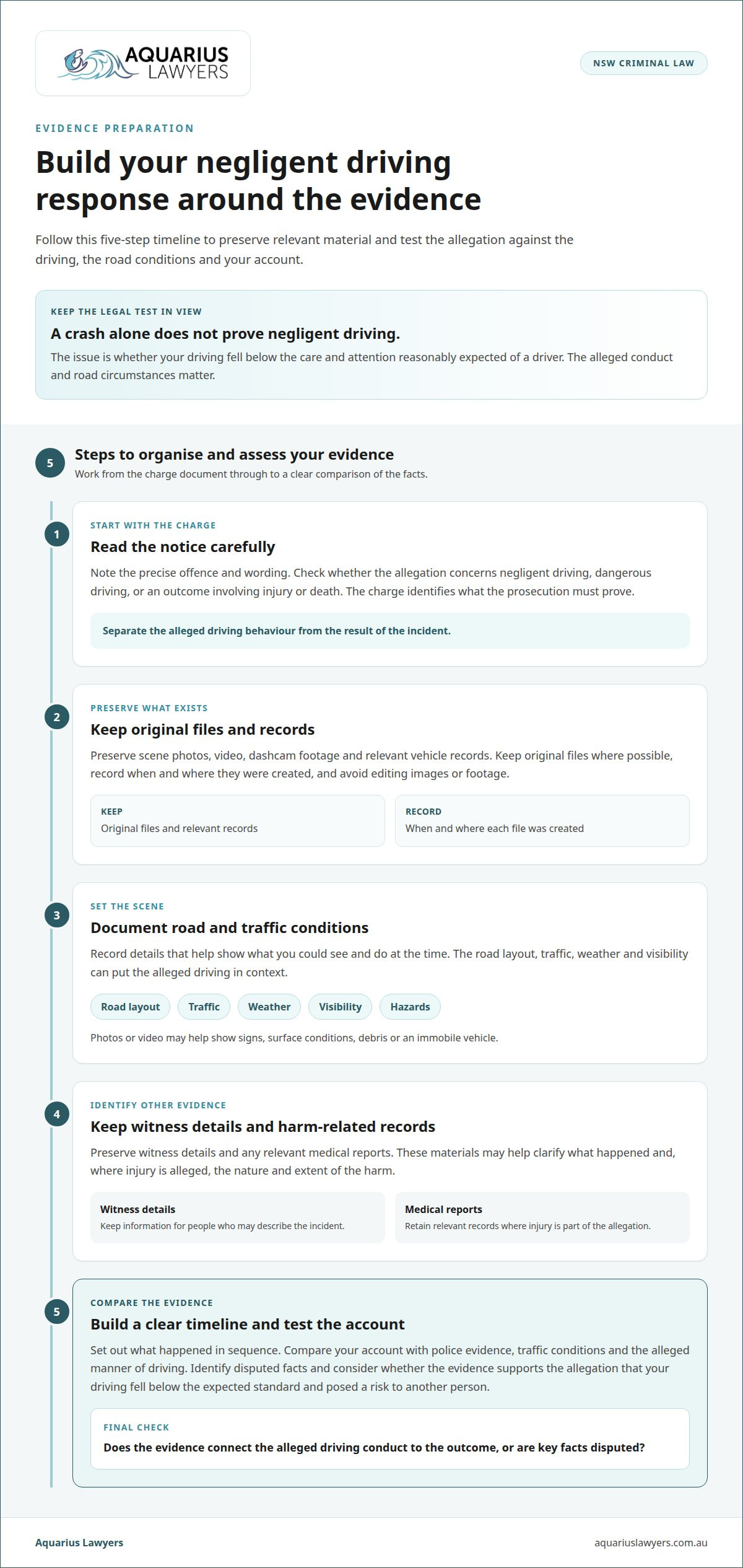
What evidence should I gather to support my defence?
Build your defence around the driving alleged, the road conditions and the evidence supporting your account. For a charge under section 117(1) of the Road Transport Act, the prosecution must prove negligent driving. The evidence should help test whether your driving fell below the standard expected of a reasonable driver and posed a risk to another person.
Preserve material from the scene and identify anyone who can describe what happened. Keep original files where possible, record when and where they were created, and avoid editing footage or images. A clear timeline can help compare your account with police evidence, traffic conditions and the alleged manner of driving.
- Scene photographs or video: Capture road layout, signs, visibility, surface conditions and hazards. Images showing debris or an immobile vehicle can help explain what was visible to a driver.
- Witness details and statements: Record names and contact details, then note what each witness personally saw. A witness who observed traffic flow may provide a different account from someone who arrived after the incident.
- Dashcam footage or vehicle GPS data: Preserve the original recording or data. These records may help establish vehicle movement, timing and the surrounding traffic.
- Medical reports or expert opinions: Gather relevant records where a medical episode affected your actions, or expert analysis can explain road or vehicle evidence.
A medical episode may be relevant if it caused involuntary action. Gather medical reports documenting the episode and its timing, then compare them with the alleged driving conduct. The issue is not simply whether you felt unwell. The evidence needs to address how the episode affected your control of the vehicle at the time.
Compare the police material with independent evidence. Check the locations and timing in witness accounts against dashcam footage, GPS records and scene images. Note any contradictions about how the vehicle was driven, traffic movement, road hazards or the sequence of events. Preserve original records so their context remains clear.
Keep the charge wording in view. Negligent driving occasioning grievous bodily harm alleges that driving below the reasonable-driver standard caused serious injury. The prosecution must prove the charge beyond reasonable doubt. Evidence of injury alone does not establish how the vehicle was driven or whether that driving caused the harm.
Dangerous driving is a distinct allegation, so identify whether police allege negligent or dangerous conduct. Organise your material by issue: driving behaviour, road circumstances, risk to others and any alleged injury or death. This makes gaps and conflicting accounts easier to identify before you respond to the charge or prepare for court.
Definition of negligent driving in NSW
Under section 117(1) of the Road Transport Act, driving a motor vehicle negligently is an offence in NSW. The central question is whether your driving fell below the care and attention reasonably expected of a driver. The prosecution must prove the charge beyond reasonable doubt. A collision alone does not establish that the driving was negligent.
The test compares your conduct with that of a reasonable driver in the circumstances. It also considers whether the driving posed a risk to another road user or someone near the road. For example, a court may consider whether a driver had time to react to a visible hazard, rather than judging the decision solely by the crash that followed.
The assessment depends on the full road setting. Relevant circumstances include the road surface, traffic volume and flow, weather, visibility and hazards. An immobile vehicle, emergency responders or debris may affect what a driver could reasonably see and do. The same manoeuvre can pose a different risk on a clear road than in heavy traffic.
Fatigue or distraction, failing to give way, running a red light, speeding and tailgating may lead to an allegation. Driving too fast for wet conditions may also be assessed against the reasonable-driver standard. These examples do not automatically prove guilt. The prosecution still needs to establish the alleged conduct and its risk in the specific circumstances.
Dangerous driving is a separate and more serious allegation. It concerns driving at a speed or in a manner dangerous to the public, while negligent driving focuses on falling below the expected standard of care. The charge wording and alleged conduct matter. A person may also face a reckless, furious or dangerous driving allegation without causing injury, so harm alone does not define the offence.
To understand the case against you, identify the exact conduct police allege and the road conditions they rely on. Compare that account with the available evidence, including traffic, hazards and any competing explanation. If the allegation involves a fatality or grievous bodily harm, the offence charged affects possible penalties, including imprisonment and licence disqualification.
Get criminal law advice to assess how the reasonable-driver test applies to your charge and evidence.
Aquarius Lawyers: Marine Law
Aquarius Lawyers’ Marine Law practice is relevant when a legal issue intersects with maritime operations or assets. Its Fisheries Law, Aquaculture Law and Commercial Law may also assist with matters involving those business activities.
These practice areas are not a substitute for advice about a stand-alone negligent driving charge. If the driving matter directly relates to your marine or commercial operations, explain that context when seeking legal guidance. This helps focus the next step on the legal issue you need addressed.
For a matter involving marine, fisheries, aquaculture or commercial interests, contact Aquarius Lawyers to discuss the relevant legal issue, or visit aquariuslawyers.com.au.
Take a considered next step
A traffic charge can affect your work, family responsibilities and ability to travel. Before responding, gather your charge documents and note any upcoming court dates or licence-related notices. Organising these details gives you a clear starting point for discussing your situation.
If you’re facing negligent driving charges in NSW, focus on the specific allegation and the practical consequences you need to manage. Avoid rushed decisions based on assumptions about how the matter will be treated. A clear account of your circumstances can help guide a focused discussion about your options.
Aquarius Lawyers offers Criminal Law. Contact the firm to discuss your charge and what to consider next.
Contact Aquarius Lawyers about your charge. Take the next step with a clear plan.
Frequently Asked Questions
Will I lose my licence?
You can lose your licence, particularly if the charge involves death or grievous bodily harm. A disqualification may be imposed by the court, and police may suspend and confiscate your licence within 48 hours of a charge or penalty notice for those offences. Check any notice for its effective date and conditions. Don’t drive if your licence is suspended or disqualified, even while you challenge the charge.
Can I go to jail for this offence?
Yes. Negligent driving occasioning death or grievous bodily harm can result in imprisonment. A basic negligent driving offence is treated differently from these injury and death offences. The court considers the charge and circumstances of the driving when deciding the penalty. If you receive a Court Attendance Notice, note the listed charge and court date, and prepare to address the allegations rather than assuming every negligent driving matter carries the same risk.
Can I still drive if I am charged?
A charge alone doesn’t tell you whether you can legally drive; check whether police have suspended your licence or a court has disqualified you. For a charge or penalty notice involving death or grievous bodily harm, police may suspend and confiscate a licence within 48 hours. Read the written notice carefully and follow its directions. If your licence status is unclear, get legal advice before driving, because a separate driving-while-suspended allegation can follow.
How serious is the charge?
The seriousness depends on the alleged conduct, the charge category and whether someone was injured or died. A basic negligent driving allegation differs from an offence involving grievous bodily harm or death, which carries the risk of imprisonment and disqualification. A conviction can also affect your record and ability to drive. Read the wording on your Penalty Notice or Court Attendance Notice to identify the allegation you need to answer.
What factors influence sentencing for this offence?
The court considers the degree of negligence and, where relevant, the type and extent of injury caused. For example, the circumstances of a failure to give way may differ from sustained dangerous conduct in heavy traffic. The court assesses evidence about the driving and its consequences, rather than relying on the outcome alone. Your response should address the specific conduct alleged and any evidence that puts the circumstances in context.
What is a serious driving offence?
Offences involving negligent driving occasioning death or grievous bodily harm are serious because they involve fatal or significant injury and carry stronger penalties. The repeat-offence rules also refer to a previous serious offence within the relevant period. For negligent driving, an offence counts as second or subsequent if it occurred within the past five years, or if there was another previous serious offence within that period.
Disclaimer
Please note that legal rules change and this is not a substitute nor construed as legal advice. It is general information only.